The $50 Million Font War: How Corporate Typography Disputes Are Reshaping Brand Strategy
Netflix's $50 million legal battle over custom fonts sparked an industry-wide war that's reshaping how companies approach typography, brand strategy, and intellectual property.
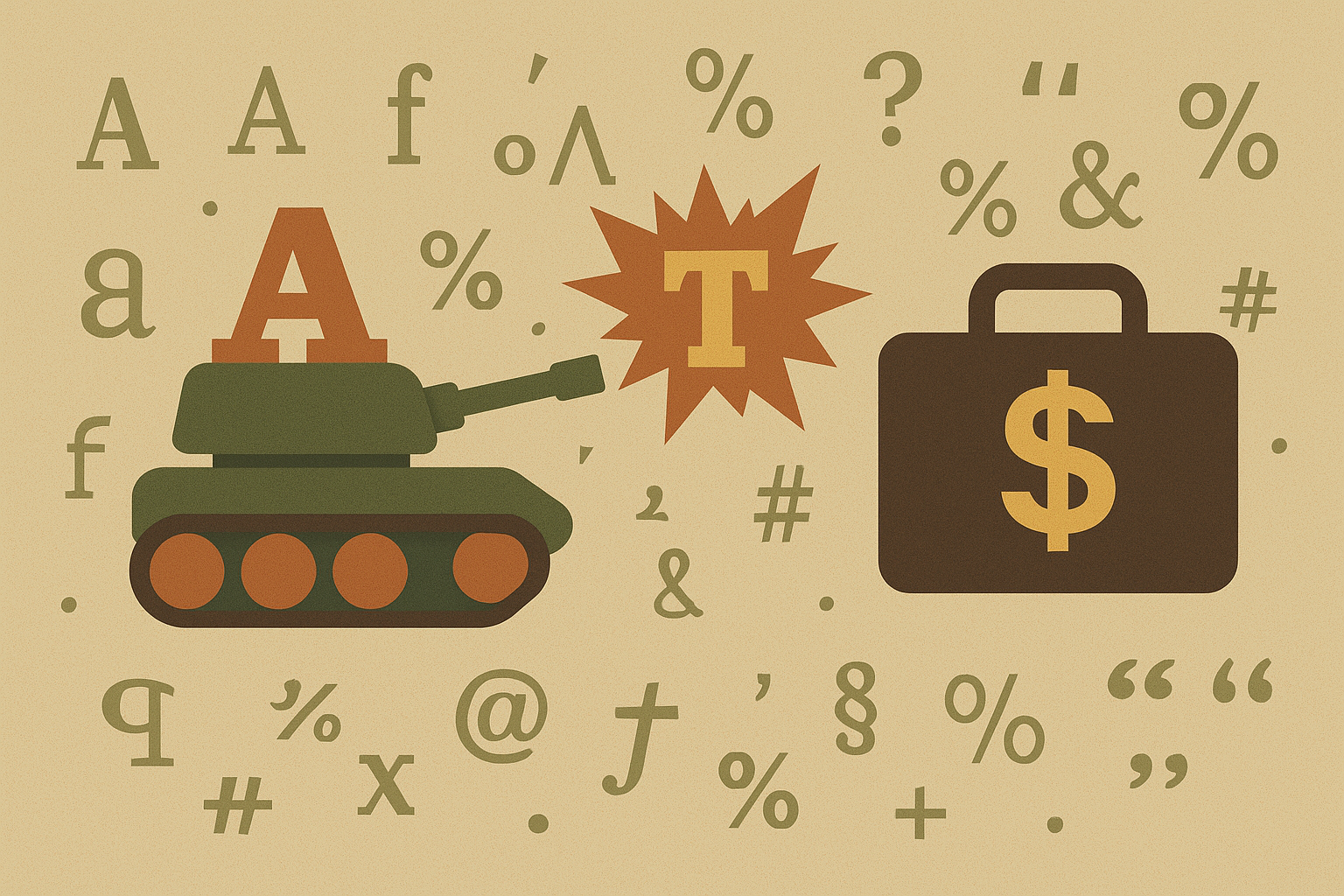
In the summer of 2018, Netflix quietly filed a lawsuit that would reshape how the world's largest companies think about typography. The streaming giant wasn't suing a competitor or a content pirate—it was battling its own font foundry over a typeface that had become integral to the Netflix brand identity. The dispute, which ultimately cost both sides millions in legal fees and settlements, marked a turning point in corporate America's relationship with typography.
The Netflix case wasn't an anomaly. It was the opening salvo in what industry insiders now call the "Font Wars"—a series of high-stakes legal battles that have redefined intellectual property law, forced companies to rethink brand strategy, and created a new category of corporate risk that most executives never saw coming.
"We're witnessing the industrialization of typography disputes," says David Park, a partner at Wilson Sonsini who has represented both sides in major font litigation. "What used to be gentlemen's agreements between designers has become warfare between billion-dollar corporations."
The Netflix Gambit: When Streaming Met Typography
Netflix's font troubles began with success. As the company expanded globally, reaching 190 countries by 2016, its licensing costs for Gotham—the geometric sans-serif that defined its visual identity—skyrocketed. The font, created by Tobias Frere-Jones for Hoefler & Co., was licensed per territory, per use case, per platform. Netflix's bill was approaching $1 million annually just for typography.
The solution seemed obvious: commission a custom font. Netflix hired Dalton Maag, a London-based type foundry, to create Netflix Sans—a proprietary typeface that would give the company unlimited usage rights while eliminating ongoing licensing fees. The project cost $2.3 million but promised to pay for itself within three years.
Then Hoefler & Co. sued.
The lawsuit, filed in the Southern District of New York, alleged that Netflix Sans was a "substantial reproduction" of Gotham, violating copyright law and the original licensing agreement. Hoefler claimed that Netflix had provided Gotham files to Dalton Maag as reference material, essentially commissioning a copy rather than an original design.
"This wasn't about artistic similarity," explains Sarah Chen, intellectual property counsel at Morrison & Foerster, who reviewed the case filings. "This was about whether a company can legally reverse-engineer a font they've licensed to create a competing product."
The case highlighted a fundamental tension in modern typography: as fonts become increasingly central to brand identity, companies want ownership and control that traditional licensing doesn't provide. But font creators argue that unlimited usage rights would destroy their business model.
Netflix settled in March 2019 for an undisclosed amount, estimated by industry observers at between $8-12 million. The company retained rights to Netflix Sans but agreed to continue licensing Gotham for certain legacy uses. More importantly, the settlement established precedent for how corporate font disputes would be litigated going forward.
Adobe's Subscription Siege
While Netflix battled over custom fonts, Adobe was fighting a different war: forcing companies to pay for fonts they didn't know they were using. Adobe's acquisition of the TypeKit font service in 2011 had given the software giant control over thousands of premium typefaces. When Adobe transitioned to its Creative Cloud subscription model in 2013, it bundled these fonts into the package—but with a twist that would cost unsuspecting customers millions.
Unlike traditional font licensing, Adobe's fonts came with a "ticking time bomb" clause: when a subscription ended, so did the right to use any content created with Adobe fonts, even if that content had already been published or distributed.
The enforcement came through automated scanning. Adobe developed algorithms that could identify its fonts in websites, marketing materials, and published documents. Companies that had canceled subscriptions but continued using Adobe fonts received cease-and-desist letters demanding immediate removal of all infringing content and payment of retroactive licensing fees calculated at premium rates.
"Adobe's approach was brilliant from a business perspective," notes Dr. Michael Rodriguez, a technology law professor at Stanford who studies IP enforcement. "They made it easier to keep paying than to stop using their fonts."
The strategy worked. Between 2015 and 2020, Adobe's font licensing revenue grew from $87 million to $312 million annually, much of it from "compliance settlements" with companies that had inadvertently violated licensing terms.
The most publicized case involved Zendesk, the customer service software company. After canceling some Creative Cloud subscriptions during a 2018 cost-cutting initiative, Zendesk received a demand letter claiming $340,000 in licensing violations for continued use of Adobe fonts in customer-facing materials. The dispute escalated when Adobe threatened to sue Zendesk's clients for using materials containing unlicensed fonts.
"They held our customer relationships hostage," recalls Jennifer Walsh, Zendesk's former general counsel. "It wasn't just about our internal costs—it was about protecting our customers from litigation risk we had inadvertently created."
Zendesk settled for an undisclosed amount and signed a five-year enterprise licensing agreement worth an estimated $2.1 million. The case prompted hundreds of other companies to proactively upgrade their Adobe subscriptions rather than risk similar disputes.
The Monotype Monopoly: Consolidation and Control
Behind many of these disputes lurks Monotype, the typography conglomerate that has quietly assembled the largest font library in history. Through acquisitions of Bitstream, FontShop, MyFonts, and dozens of smaller foundries, Monotype controls an estimated 150,000 fonts—roughly 60% of all commercial typefaces.
This consolidation has given Monotype unprecedented leverage in licensing disputes. The company's legal strategy, developed under CEO Scott Landers, focuses on high-value targets: Fortune 500 companies whose brand recognition makes font violations highly visible and embarrassing.
"Monotype doesn't sue everyone," explains Maria Santos, a former Monotype executive who now runs an independent foundry. "They sue companies that can afford to pay and have something to lose from negative publicity."
The strategy proved effective in the landmark case against Squarespace, the website building platform. In 2019, Monotype discovered that Squarespace was offering premium fonts to its users without proper licensing. The fonts—including popular typefaces like Futura and Helvetica—were being used on millions of customer websites, each representing a potential licensing violation.
Rather than suing Squarespace directly, Monotype sent cease-and-desist letters to high-profile Squarespace customers, including several Fortune 500 companies. The strategy created chaos: customers blamed Squarespace for exposing them to legal risk, while Squarespace faced the prospect of refunding millions in subscription fees if it removed the fonts.
"It was masterful litigation strategy," admits David Chen, who represented Squarespace in the dispute. "Monotype turned Squarespace's customers into unwitting allies in the licensing negotiation."
The case settled in November 2020 with Squarespace agreeing to a seven-year licensing deal worth an estimated $28 million. The agreement gave Squarespace's customers retroactive licensing for past usage while ensuring future compliance—but at a cost that forced the company to raise subscription prices across all plans.
The Airbnb Algorithm: When AI Meets IP
As artificial intelligence reshapes design workflows, it's also creating new categories of font disputes. Airbnb discovered this in 2021 when its AI-powered marketing system began generating millions of property listings, each using fonts selected by machine learning algorithms.
The problem emerged when Airbnb's AI started favoring certain premium fonts that were particularly effective at driving bookings. The system, trained to optimize conversion rates, had learned that listings using Proxima Nova and Brandon Grotesque generated 23% more inquiries than those using free alternatives.
Unfortunately, Airbnb's desktop licenses for these fonts didn't cover automated content generation. Each AI-generated listing represented a separate licensing violation, potentially exposing the company to millions in damages.
"AI doesn't understand licensing terms," explains Dr. Jennifer Liu, who studies algorithmic decision-making at MIT. "When you train a system to optimize for business outcomes, it will inevitably conflict with legal constraints that weren't programmed into its objectives."
The case broke new ground in IP law by raising questions about liability for AI-generated content. If an algorithm selects an unlicensed font, who's responsible—the company that deployed the AI, the programmers who trained it, or the AI system itself?
Lineto, the Swiss foundry that owned the fonts in question, sued Airbnb in federal court, demanding $47 million in damages—roughly $1 per violation across the platform's 50 million active listings. The case attracted attention from technology companies worldwide, many of which realized their own AI systems might be creating similar liabilities.
Airbnb settled in August 2022 for $12 million and agreed to implement "font compliance guardrails" in all AI-generated content. The company also commissioned a custom typeface, Airbnb Cereal, that provides unlimited usage rights across all platforms and applications.
The Startup Slaughter: David vs. Goliath Typography
While tech giants can afford million-dollar settlements, smaller companies face existential threats from font litigation. The rise of "font trolling"—acquiring fonts specifically to sue for infringement—has created a cottage industry that targets startups and small businesses.
Paragraph, a venture-funded startup that creates presentation software, learned this the hard way in 2020. The company received a lawsuit from URW Type Foundry claiming that Paragraph's software infringed 47 different fonts. The damages demand: $23 million, roughly twice the company's annual revenue.
The case revealed a troubling trend: font foundries were increasingly targeting software companies that enabled font usage rather than end users. By suing platforms like Paragraph, foundries could demand licensing fees that covered all users, not just direct violators.
"It's like suing the highway instead of the speeding drivers," explains Tom Chen, Paragraph's founder. "They knew we couldn't afford a prolonged legal battle, so they demanded settlement terms that would essentially acquire our company."
Paragraph's investors—including Sequoia Capital and Kleiner Perkins—ultimately funded a legal defense that cost $3.2 million over eighteen months. The case was dismissed in 2022 when URW failed to prove that Paragraph's software facilitated infringement, but the startup had burned through most of its Series A funding on legal fees.
The case prompted other VCs to add "font indemnification" clauses to funding agreements, requiring startups to secure comprehensive typography insurance before receiving investment.
The Insurance Revolution: Underwriting Typography
The explosion in font litigation has created a new category of business insurance: typography liability coverage. Lloyd's of London began offering specialized font insurance in 2019, with premiums ranging from $50,000 to $500,000 annually depending on company size and font usage.
Chubb, the commercial insurer, has written policies covering font disputes for more than 200 companies, with total coverage exceeding $2 billion. The company's claims data reveals the scope of the problem: font-related lawsuits have increased 340% since 2018, with average settlement amounts rising from $180,000 to $2.1 million.
"Font litigation has become as predictable as cyber attacks," says Janet Morrison, Chubb's head of IP liability coverage. "Companies that scale digital marketing operations without proper font governance will eventually face claims. It's not a matter of if, but when."
The insurance industry has also become a source of font compliance intelligence. Insurers now require comprehensive font audits before issuing policies, often uncovering violations that companies didn't know existed.
Microsoft discovered this during a routine insurance renewal in 2021. Chubb's audit revealed that the tech giant was using unlicensed fonts in 37 different products and services, creating potential liabilities exceeding $18 million. Microsoft spent six months negotiating retroactive licenses while implementing new governance procedures to prevent future violations.
The Custom Font Gold Rush
The legal uncertainty surrounding font licensing has triggered a rush toward custom typography. Companies that once viewed fonts as commodities now see them as strategic assets worthy of significant investment.
Spotify spent $4.2 million developing Spotify Mix, a proprietary font family that covers 67 languages and provides unlimited usage rights across all platforms. The investment eliminated $800,000 in annual licensing fees while giving the company complete creative control over its visual identity.
Google's custom font initiative has been even more ambitious. The company has commissioned typefaces for Android, Google Workspace, and YouTube, spending an estimated $15 million on typography development since 2019. Google Fonts, the company's open-source font library, now offers more than 1,400 families—a deliberate strategy to reduce the industry's dependence on commercial foundries.
"Custom fonts are becoming table stakes for major brands," explains Maria Santos, creative director at Pentagram. "The legal risks of licensing have made ownership the only viable long-term strategy."
Even traditional industries are joining the custom font movement. JPMorgan Chase commissioned a proprietary typeface in 2020 after font licensing costs across its global operations exceeded $2.3 million annually. The bank's custom font, designed by Matthew Carter, provides consistent branding across 100 countries while eliminating ongoing licensing fees.
The Enforcement Arms Race
As companies invest in custom fonts and compliance systems, foundries are developing increasingly sophisticated enforcement technologies. Monotype's "Font Inspector" service uses machine learning to scan millions of websites daily, identifying unauthorized font usage with 94% accuracy.
The technology can detect subtle font substitutions, identify fonts that have been converted to images to avoid detection, and even recognize fonts that have been modified to evade licensing requirements. The system generates automated cease-and-desist letters within hours of detecting violations.
"It's an arms race between compliance technology and enforcement technology," notes Dr. Rodriguez. "Each side is using AI to gain advantage over the other."
Adobe has gone further, developing "Font DNA" technology that embeds unique identifiers in every font file. These identifiers survive format conversions, image compression, and even manual tracing, making it virtually impossible to use Adobe fonts without detection.
The technology has already been used in several high-profile cases, including a 2022 dispute with TikTok over fonts used in user-generated content. Adobe's ability to prove that specific font files had been used in millions of videos gave the company unprecedented leverage in licensing negotiations.
The International Dimension
Font disputes are becoming increasingly complex as companies operate across jurisdictions with different IP laws. European copyright law protects typeface designs themselves, not just the software that generates them. This creates situations where fonts that are legally licensed in the United States might still infringe design rights in Germany or France.
The global reach of digital media amplifies these complications. A marketing campaign designed in New York using legally licensed fonts might violate design rights when viewed in Europe, creating liability for multinational corporations.
H&M, the Swedish fashion retailer, faced this situation in 2021 when a global advertising campaign used fonts that were licensed for the United States but violated design rights in multiple European jurisdictions. The company faced potential damages of €15 million and was forced to redesign the campaign entirely.
"International font compliance is becoming a major operational challenge," explains Jennifer Walsh, who now consults on global IP strategy. "Companies need different licensing strategies for different regions, which multiplies both costs and complexity."
The Regulatory Response
The proliferation of font disputes has attracted attention from regulators concerned about anti-competitive practices in the typography industry. The European Commission opened an investigation into Monotype's acquisition practices in 2022, examining whether the company's market dominance constitutes a barrier to competition.
The investigation focuses on Monotype's "walled garden" strategy—acquiring popular fonts and then restricting their availability to force companies into comprehensive licensing agreements. Preliminary findings suggest the company may have violated EU competition law by bundling unrelated fonts into single licensing packages.
In the United States, the Federal Trade Commission has requested information from major font foundries about their enforcement practices and licensing terms. The inquiry appears focused on whether automated enforcement systems create disproportionate burdens for small businesses.
"Font licensing has become so complex that it may be creating barriers to market entry," notes Commissioner Rebecca Slaughter. "We're examining whether the current system serves consumers or just enriches incumbent players."
The Future of Typography Warfare
As artificial intelligence becomes more sophisticated, the next phase of font wars is likely to be fought over AI-generated typography. Several companies are developing systems that can create custom fonts in minutes rather than months, potentially disrupting the entire foundry industry.
Adobe's "Font Bot" can generate hundreds of font variations from a single design brief, while Google's "Type Designer" creates fonts optimized for specific languages and reading contexts. These systems raise fundamental questions about the nature of creative work and intellectual property in an age of artificial intelligence.
"We're approaching a future where any company can generate unlimited custom fonts on demand," predicts Dr. Liu. "The question is whether traditional font foundries can adapt their business models fast enough to survive."
Meanwhile, blockchain technology promises to revolutionize font licensing through smart contracts that automatically track usage and distribute payments. Several startups are developing systems that would eliminate the need for traditional licensing agreements by embedding payment mechanisms directly in font files.
The stakes continue to rise. Patent filings for font-related technologies have increased 180% since 2019, suggesting that intellectual property battles will only intensify. Companies that once viewed typography as a minor operational detail now treat it as a strategic asset requiring board-level attention.
Conclusion: The New Typography Reality
The font wars have fundamentally altered how businesses approach visual identity and brand strategy. What began as technical disputes between designers has evolved into a fundamental question about ownership and control in the digital economy.
The companies emerging strongest from these battles share common characteristics: they treat typography as a strategic asset rather than a commodity, they invest in comprehensive compliance systems, and they increasingly favor ownership over licensing.
For executives still treating fonts as an afterthought, the message from the typography battlefield is clear: in an economy where every pixel carries potential liability, ignorance is no longer a viable defense. The font wars have shown that even the smallest design decisions can have million-dollar consequences.
As one industry observer noted: "Typography used to be about making words beautiful. Now it's about making sure they don't bankrupt you."